Journal
Commissioning custom lighting in Lebanon
October 2026 · Guide
A custom light is not chosen from a catalogue: it is designed for one space, engineered, made and installed. Here is how the process works, and how to prepare so your project runs smoothly, whether you are an architect, an interior designer or an owner.
1. Prepare a clear brief
- Drawings of the space: plans, sections and ceiling heights, or photos and dimensions if drawings do not exist yet.
- References: images of the mood, materials and light you are after.
- The role of the light: a statement piece, functional light over tables, or both.
- Budget range and deadline: they shape every decision, from materials to quantity.
- Who decides: the designer, the owner, the contractor, and who signs off each stage.
2. Design development
The concept becomes something buildable. Expect sketches and a 3D model to agree on form, scale and density, and material samples to see how the stone, metal or finish behaves with light. For larger pieces, a sample or partial mock-up is the best way to confirm the effect before production.
3. Engineering
- Weight and structure: what the ceiling or wall can carry, and where the fixing points go.
- Electrical: light sources, drivers, dimming and control, including DALI or smart systems.
- Maintenance: how a light source is reached and replaced in five years.
- Moving parts: joints, arms or rotation, designed to stay precise over time.
4. Fabrication
Components are cut, shaped, finished, wired and tested in the workshop. Lead time depends on materials, finishes and quantity: one lamp and a ceiling of hundreds of pieces are very different projects. Agree on the schedule and on checkpoints, such as a visit to the workshop, before production starts.
5. Installation
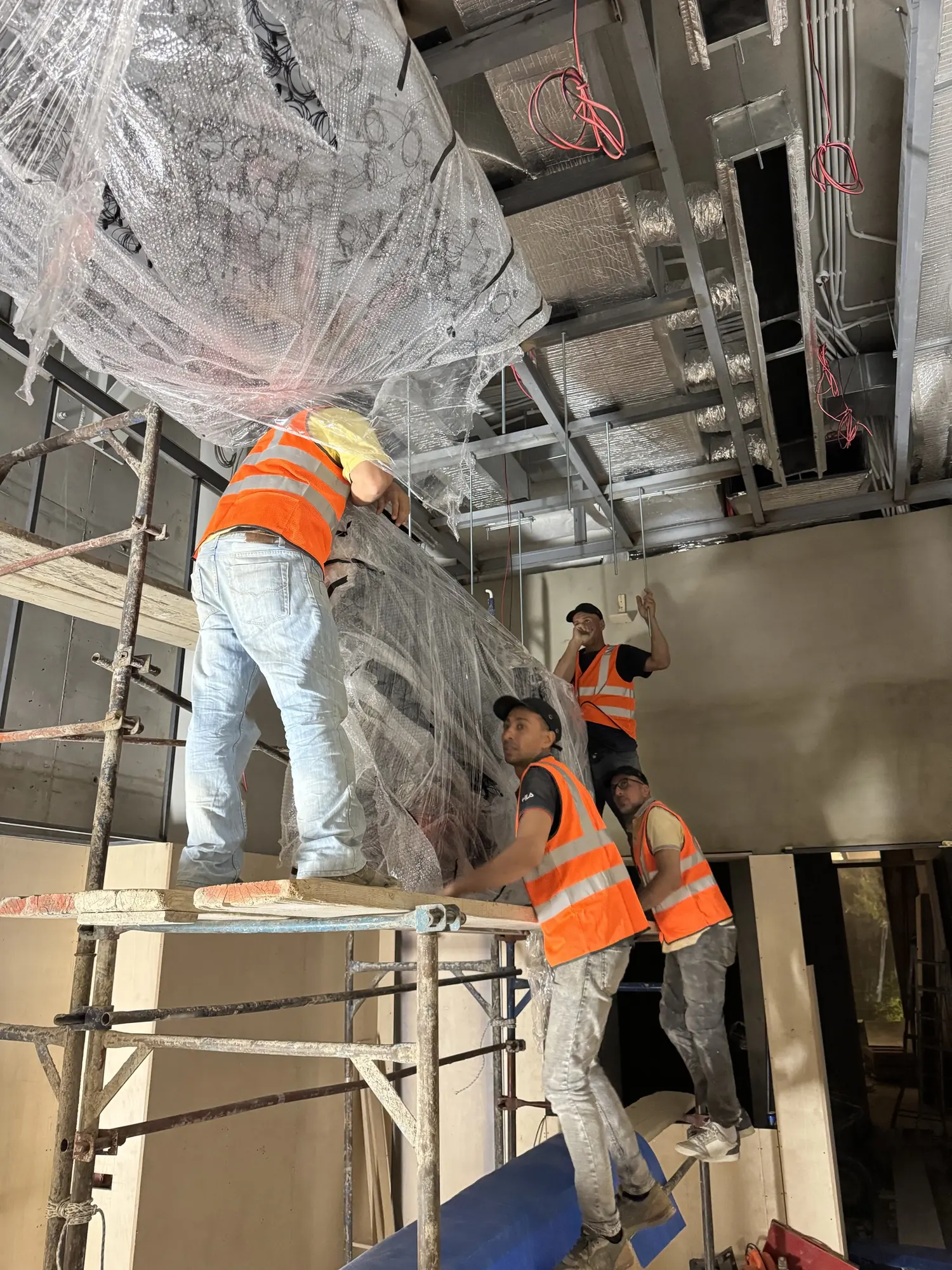
Coordinate with the contractor before ceilings are closed, so the fixing points, cables and access are ready. Plan scaffolding or lifts for high ceilings. The piece is then installed, connected, adjusted and tested in place, ideally with the designer present for the final tuning.
Example
For Skirt Faqra, 600 hand-shaped pieces of pink onyx were modelled in 3D, wired one by one and hung from a ceiling plate. For By Skirt, four steel wall lamps with pivoting joints were sized to the room and connected to the restaurant's DALI control. Read how we built the Skirt ceiling.
Questions
How long does a custom lighting piece take?
It depends on the size, the materials and the number of pieces. A single fixture is much faster than a ceiling installation of hundreds of parts. Bring us your deadline early and we will tell you what is realistic.
What drives the cost of custom lighting?
Mainly the materials (natural stone and custom metalwork cost more than standard parts), the number of components, the complexity of the engineering and wiring, the finishes, and the installation conditions such as ceiling height and access.
Can custom lighting connect to DALI or a smart system?
Yes, if it is planned from the start. Drivers, dimming and control are chosen during engineering so the piece works with the building's lighting control.
Who should we involve, the designer or the fabricator?
Both, early. The designer owns the intent; the fabricator makes it buildable. Involving the fabricator while the design is still open saves time and money.
Have a project in mind?
Send us your space, drawings or references on Instagram and we will get back to you.